
A Global Review of Consumer Demand for Ethical Transparency in Supply Chains
Consumer demand for ethical transparency in supply chains is global, as our review of research from major consultancies, UN agencies, and research institutions shows. Our review of global research uncovers important trends, including the significantly increasing importance of ethics to younger generations.
• PwC’s global tracking study across 31 countries shows that over 80% of consumers are willing to pay a price premium – averaging 9.7% – for products that offer full, verified supply chain transparency and ethical sourcing. PwC Global & China Consumer Survey (2024)
• Recent global tracking by the IBM Institute for Business Value reveals a massive surge in values-based commercial demand: 73% of consumers who prioritize sustainability and corporate accountability are willing to pay a price premium for products that demonstrate authentic, sustainable practices. IBM IBV (2024)
• GlobeScan’s global study across 13 countries confirms that Fairtrade remains the world’s most recognized and trusted ethical label. 75% of shoppers recognize the mark (with 83% trusting it), and two-thirds (66%) of consumers agree that the label is their primary tool to help them identify ‘fair’ and ethically sourced products. Fairtrade × GlobeScan (2025)
• National awareness tracking by the Government of Japan reveals that 36.1% of Japanese consumers actively practice ethical consumption, supported by the Japanese government which promotes and funds ethical shopping and transparency as a formal national policy. Consumer Affairs Agency (2024)
• National tracking on ‘Value Consumption’ (Gachi-sobi) in South Korea reveals that 66.9% (exactly two-thirds) of Gen Z consumers are willing to pay a price premium to purchase from companies practicing verified ESG and ethical sourcing. Korea Chamber of Commerce & Korea Consumer Agency (2024–2025)
• National tracking in India reveals that 83% of consumers state that transparent data practices and product integrity are primary trust factors, driving 60% of Indian shoppers to actively shift toward sustainable/ethical alternatives with a willingness to pay up to a 13.1% price premium for verified supply chain integrity. PwC India Consumer Survey (2024)
• Global retail data from the Sustainability Claims Tracker shows that while over 60% of Swedish and EU consumers prioritize environmental and social impact in their purchases, only 1.2% of products on Swedish digital shelves carry verified carbon-neutral or sustainable claims, exposing a severe information and trust bottleneck. Euromonitor International (2024)
• 57% of New Zealanders state that a company’s ethics (such as fair wages and safe working conditions) are important to them when deciding where to shop and which brands to purchase. This figure rises to 64% for Millennials (aged 25-34). Fair&good (2022)
Gen Z are creating an Intergenerational Shift
A remarkable intergenerational shift is dramatically increasing demand for supply chain transparency. Gen Z is significantly more concerned about and proactively responding to ethical supply chain issues when shopping compared to previous generations.
• For 31% of young adults (aged 18–29), the “fair treatment of employees” is the single most important factor influencing their daily purchasing decisions. Kantar Better Futures (2025)
• 83% of Gen Z consumers expect brands to take a clear stance on social issues (compared to just 59% of consumers aged 41 and older). As the study notes: “It is clear that the next generation wants businesses and companies to support the causes they believe in … in order to become the brand of choice for Gen Z, companies need to not only communicate, but also act, with ethical standards.” Maersk (2022)
• A landmark generational study in Brazil reveals that consumption has fundamentally shifted to become a major ethical concern, with 70% of Gen Z consumers actively trying to purchase exclusively from companies they consider ethical. McKinsey & Company (2018)
• 73% of Gen Z consumers report that they will only buy from brands they believe in, with 57% expecting a brand’s stance on key social/ethical issues to be visible directly at the point of transaction. Edelman Trust Barometer (2022)
The Aspiration-Action Gap
A very important finding across multiple independent research studies is that consumers want to make ethical purchasing decisions but cannot, because the tools and information do not exist in an accessible form. This is the “Aspiration-Action Gap”.
Environmental sustainability has a smaller aspiration-action gap, having benefitted from the availability of clear, accessible information — recycling labels, energy ratings, carbon footprint data and so on. Ethical data lacks equivalent infrastructure, resulting in a larger aspiration-action gap. An ethics link type would provide the same kind of accessible social data that already exists for environmental concerns, closing the ethics aspiration-action gap.
• There is a 28 percentage-point difference between consumers who say “I care” (64%). about environmental sustainability issues and those who say “I act” (36%).
• There is a 39 percentage-point difference between consumers who say “I care” (58%) about social justice issues and those who say “I act” (19%).
Kantar Better Futures (2025)
• While 57% of New Zealanders said they aspired to shop ethically, only 33% said they were able to relatively easily identify brands or products that were ethically produced, suggesting a 24 percentage-point aspiration-action gap, supporting other research which identifies the gap as related primarily to lack of easy access to standardised trustworthy information. Fair&good (2022)
Consumers don’t have the information they need to shop ethically
• Global consumer research spanning 20,000+ consumers across 26 countries found that only 41% of consumers believe they have sufficient information to shop sustainably or ethically, indicating that the barrier is information infrastructure, not intention. IBM Institute for Business Value (2024)
• While 57% of New Zealanders said they aspired to shop ethically, 67% stated that it was hard to know which brands or products are ethically produced. This was attributed to a lack of information, limited disclosure by brands, uncertainty about trustworthiness, and no standardised way to compare brands. Fair&good (2022)
• National UK research demonstrates that consumer awareness of modern slavery actively influences purchasing behavior only when credible, verified information is made visible at the point of sale. Modern Slavery PEC Study (UK 2021)
Ethics now outperforms environmental issues in brand perception
• For 31% of young adults (aged 18-29), “fair treatment of employees” is the single most important factor influencing their brand perception and purchase choices. Kantar Better Futures (2025)
• Among consumers who prioritize corporate ethics, 45% identify fair wages as the most critical factor, followed by safe working conditions (36%), and environmentally friendly production (13%). Fair&good (2022)
Consumers are willing to pay more for ethical products
• Independent polling reveals a massive consumer mandate for ethical supply chains: over 50% of consumers would pay up to 10% more for everyday items (such as food, tea, coffee, and clothing) if they could be guaranteed that the products were verified as slavery-free. Walk Free Foundation / Minderoo (2019)
• Annual multi-market tracking reveals that 51% of global shoppers are willing to pay a price premium specifically for products from brands that operate ethically. Ipsos Global Trends (2025)
• PwC’s global tracking study across 31 countries shows that over 80% of consumers are willing to pay a price premium – averaging 9.7% – for products that offer full, verified supply chain transparency and ethical sourcing. PwC Global & China Consumer Survey (2024)
Businesses with low trust and poor ethical credentials are being avoided
• 51% of global shoppers state they would actively refuse to purchase from brands that fail to act on ethical and social issues. Ipsos Global Trends (2025)
• 46% of UK consumers and 66% of US consumers would immediately switch brands to avoid purchasing goods associated with modern slavery in their supply chains. Walk Free Foundation / Minderoo (2019)
• Active social protection is now a dominant commercial driver: minimising social harm accounts for 28% of overall brand perception—nearly double the impact of environmental sustainability credentials (15%). Kantar Better Futures (2025)
• An exhaustive study spanning 33,000+ respondents across 28 countries shows that consumer trust in Business (64%) is highly conditional. There is a 17 percentage-point gap between what consumers expect businesses to do on trust-building and what they perceive them to actually be doing. Edelman Trust Barometer (2022)
Being ethical is a business advantage; ethical businesses are increasingly attracting consumer loyalty
• A comprehensive five-year joint study of actual U.S. retail sales data across 600,000 SKUs and 44,000 brands reveals that products with verifiable ESG (Environmental, Social, Governance) claims demonstrably outperform conventional alternatives:
• 28% cumulative growth for products featuring verified ESG claims, compared to just 20% for those without.
• 56% of all retail growth across the categories studied was driven directly by products making verified ESG claims. McKinsey & Company & NielsenIQ (2023)
• “Though undoubtedly discerning, the next generation of ethical consumers are intensely loyal, and by meeting their demands companies can achieve long-term growth for generations to come.” Maersk (2022)
• “Brands that act authentically by aligning their actions with their values … are rewarded with loyalty and advocacy.” Kantar Better Futures (2025)
Investment echoes the demand for ethics
• A comprehensive joint annual study of New Zealand consumer investment preferences reveals a profound, resilient public demand for ethical oversight and human rights compliance:
• 75% of New Zealanders expect their KiwiSaver and managed funds to be invested ethically and responsibly.
• 59% would immediately switch their funds if they discovered their investments held unethical assets.
• 91% of investors demand that companies violating human rights be actively avoided in their portfolios.
• 91% of investors demand that companies abusing labour rights be actively avoided.
• 89% of investors demand that companies causing environmental damage be actively avoided. Mindful Money & RIAA (Voices of Aotearoa Study, 2025)
Technology that identifies ethical information is quickly adopted and changes consumer behaviour
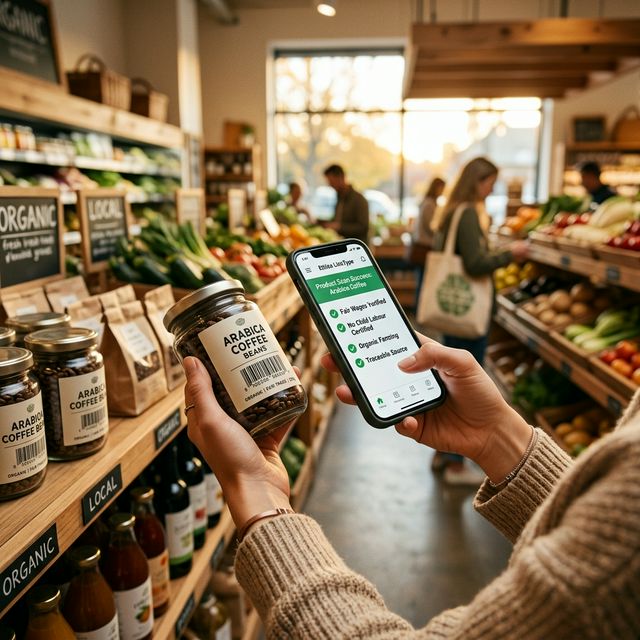
The success of existing digital discovery tools proves that if easy access to machine-readable (scannable) ethical data is created, the market will respond. Nutri-Score and the Yuka app both prove that when complex metadata is simplified into a standardized digital format, it immediately triggers massive shifts in consumer behavior and corporate practice. An ethics link type in GS1 2D Barcodes is the missing key to unlocking this same transformative effect for human rights and fair trade.
The Yuka Effect
The Yuka App scans linear GS1 barcodes to provide independent health, additive, and ethical impact scores. The Yuka app proves that consumers are already using GS1 identifiers to search for (non-standardised) ethical and health data at the point of purchase to inform their purchasing decisions, creating what economists call the “Yuka Effect.”
- Global Scale: Yuka has grown to over 80 million active users globally across 12 countries.
- Consumer Impact: Exhaustive user surveys show that 94% of users will put a product back on the shelf if the app delivers a poor scannable score.
- Manufacturer Reformulation: In response to scannable consumer pressure, 78% of manufacturers acknowledge that they have reformulated their products specifically to improve their scannable score (e.g., French supermarket Intermarché reformulated 2,300 private-label products to protect their scores).
Nutri-Score
Nutri-Score translates complex, multi-variable nutritional metadata into a simple A–E visual scale on product packaging and digital displays. Its rapid adoption across the EU illustrates the immense power of high-precision metadata.
- Habit Modification: Large-scale research shows that 57% of consumers permanently modified at least one purchasing habit as a direct result of scannable or visible nutritional rating systems.
- Commercial Redirection: Product categories with high Nutri-Score ratings (A/B) have seen sales trend steadily upward, while poor ratings (D/E) have triggered consistent downward sales trends.