

Spending our money ethically is one of the most powerful tools we all have to create change.
Every purchase tells a story about what we value, what we are willing to accept, and what
kind of world we want to live in. Our everyday shopping has real-world impact and, when
enough people use it intentionally, it can become a force for social justice.
ETA’s theory of change is simple, practical and very ambitious: Harness the
purchasing power of conscious consumers to change demand and mainstream
ethical consumption. This will break through development’s glass ceiling and create
revolutionary change globally by placing agency directly into the hands of workers,
empowering them with prosperity and opportunity, free from poverty and exploitation.
Summary: The change pathway
- Consumers become aware of their power. They understand that spending is never neutral and that their purchasing choices either support exploitation or create change.
- Brands provide ethical transparency via 2D Barcodes. Early adopter brands provide easy-to-access trusted product supply chain information, leading the way for others.
- Consumers scan for trusted transparency. 2D barcodes give shoppers access to verified ethical information at the point of sale, enabling them to shop their values in the moment.
- Consumers choose ethical products more often. With better trusted information, ethical shopping becomes easier and more habitual.
- Demand for ethical products grows. As more people buy ethically the market signal becomes stronger, reaching a tipping point.
- Retailers and businesses respond. As momentum grows, more businesses respond by sourcing and stocking products and brands that meet high ethical standards.
- Supply chains shift. Fairer wages, safer working conditions, transparency, and respect for workers become increasingly expected.
- Ethical consumption is mainstreamed and ethical production is normalised.
- Lives and communities are transformed. Workers, makers, farmers and creators gain greater income, dignity, freedom, agency, security, and opportunity to thrive, free from poverty and exploitation.
The Problem: Development has a glass ceiling
After decades of experience in development practice, academia and governance, ETA’s co-
founder, Dr Susan Maiava, identified unresolved income inequality as the glass ceiling that
limits development. Development cannot be fully achieved while income disparity remains.
As long as workers are paid too little for the goods they produce, development efforts can
only go so far or are even undermined.
“Working poverty is especially pernicious since it reflects the situation of people who,
despite being employed, still live in poverty. In other words, their employment income
is not enough to lift them and their families out of poverty” ILO 2015.
Working hard isn’t enough. We begin with a confronting observation: poverty, exploitation,
and inequality are built into global supply chains. Current economic mechanisms are failing
the world’s most vulnerable workers. Ordinary men and women (and children) are working
hard to support their families, but it is just not enough. Sadly, consumers are unwittingly
complicit in this exploitation buried deep within the supply chains of everyday consumer
products.
In the global chocolate industry, for example, chocolate companies confirm that 47% of their
cocoa farmers are not earning a living income. Alarmingly, for 37% of cocoa farmers,
companies simply do not know what they are paid due to a severe lack of supply chain data
transparency, in an industry known for widespread child labour. Chocolate Scorecard (2026)
Consumers are not detached from the problem. The glass ceiling caused by unresolved
income disparity originates in what we pay for the products we consume. What we buy and
what we are willing to pay all send signals to the market. When low prices are achieved
through low wages, long hours and unsafe conditions, ordinary consumption unintentionally
reinforces injustice.
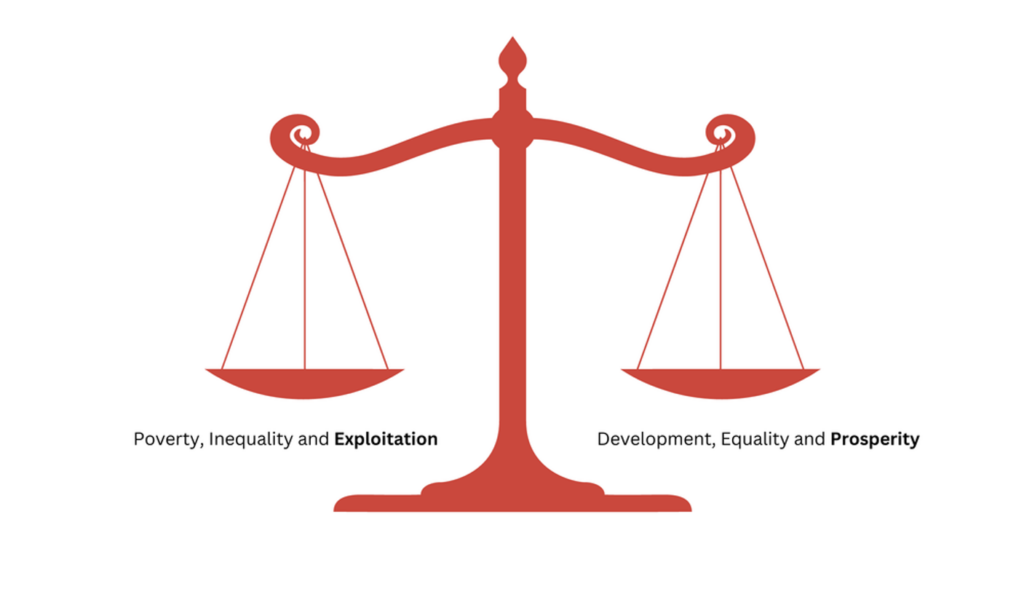
Consider the Scales of Justice. Imagine one pan is poverty and inequality, exploitative
supply chains, unfair pay and working conditions, even child, slave or bonded labour. The
other pan is development, equality and prosperity, agency and opportunity.
Every time we shop, we are putting our money into either one pan or the other. Our spending is never neutral. Every time we shop, we are choosing either exploitation or prosperity for the people who make the products we buy.
Poverty and Exploitation versus Development and Prosperity
The Insight: Consumer demand can tip the scales
ETA’s central insight is that the same purchasing power that contributes to exploitation can also be redirected toward fairness. While westernised consumers are unwittingly complicit in injustice, they also have the power to create change.
The key to breaking through the glass ceiling lies in their purchasing power. Every time consumers choose ethical products, they add weight to the side of development, equality, and prosperity.
ETA’s theory of change, then, is to harness the collective purchasing power of consumers to shop ethically, reach a tipping point, change demand and demand change.
The tipping point will happen when more consumers put their money in the prosperity pan than the exploitation pan; when consumer demand becomes so strong that retailers and suppliers can no longer treat ethical products as a niche interest and change becomes inevitable.
This is the point where consumer demand really starts to have an impact: when retailers respond by stocking their shelves with ethically sourced products as their new normal and the demand for ethics and transparency ripples back through supply chains.
Take free range eggs for example or reducing the use of plastic packaging. Suppliers and retailers responded because consumers demanded change. Businesses that responded by stocking free range eggs or replacing plastic packaging with sustainable alternatives are now reaping the rewards in both customer loyalty and profit. Research shows their profits have increased, not decreased.
The tipping point is real, and it works. But achieving a tipping point depends on a critical mass of individuals integrating ethical choices into their everyday shopping habits and lifestyle.
Remarkably, however, the market adoption tipping point needs to capture only 16% of the market. At this critical transition point Innovators (2.5%) and Early Adopters (13.5%) have changed their behaviour and a product moves out of the early market stage and enters mainstream adoption.
Above 16%, word-of-mouth and network effects take over automatically, although the first 16% of users must act as highly visible case studies for the rest to follow and continue the momentum. When that point is successfully crossed, growth accelerates exponentially, creating “J-curve” growth.
The result: a paradigm shift in ethical consumption. Consumer demand for ethical products will create systemic change, rippling back through global supply chains, resulting in the mainstreaming of ethical consumption, rewarding workers with prosperity, freedom, and agency, free from poverty and exploitation.
The Solution: Mainstream ethical consumption
We are used to thinking of ethical consumption as niche. Harmless enough and nice to have, but not a game changer. ETA wants to reframe that understanding: The mainstreaming of ethical consumption has the power to change the world.
We want to leverage that power for maximum impact so we can create a world where everyone is able to thrive, flourish and prosper, not just a few.
Ethical consumption cannot remain a specialist lifestyle choice for a small group of already-convinced shoppers. To create meaningful change, it needs to become mainstream: easy, visible, trusted, and part of everyday life for consumers.
ETA’s theory of change recognises that scale matters. Small ethical brands and artisan enterprises can create deep impact, especially in specific communities. But at the same time, larger companies and mainstream retailers have the potential to improve conditions for many more people because they employ more workers, buy from more producers, and influence wider industry expectations.
The point is not to choose between small and large, but to raise expectations across the whole market. Ethical consumption becomes powerful when conscious consumers en masse reward businesses that do better and avoid those that do not.
And once past the tipping point, ethical consumption will become normal business practice, meaning that the rest of the population will be presented with ethically sourced products as their first choice.
With mainstreaming, ethical consumption will become is a powerful path to achieving development goals. It has huge potential to transform the lives of literally millions of workers, makers and creators of the products we buy every day, right along the supply chain and on a massive scale
The Strategy: Harness consumer power to change demand
We are re-shaping the narrative; communicating a powerful new way for consumers to end exploitation and achieve development. The importance of consumer choices cannot be overstated. Every dollar spent counts. Every purchase can have purpose. Every shopper can be a conscious consumer, assert their agency and contribute to creating a world where poverty and exploitation are replaced by dignity and opportunity for all.
The research is clear Link to Global Review Blog: Consumers WANT to make ethical choices. They don’t want to be complicit in exploitation. They want to shop with integrity and make a difference. They want to shop their values. They want to use their shopping superpower for good.
But ethical consumption often fails at the point of purchase. ETA’s own research shows that 67% of New Zealanders find it hard to identify which products and brands are ethically sourced. This is repeated globally. The result is an ‘Intention-Action Gap’.
Every consumer can be a change agent, but only if they are empowered with the knowledge they need to make ethically informed choices at the point of sale.
We need to remove the obstacles. Ethical shopping must be easy, comprehensive, trustworthy, normalised, even expected. We know consumers care about workers, fair wages, modern slavery, and ethical sourcing, but they rarely have the trusted information at the point of sale when they need it.
This is where 2D Barcodes will be a complete game changer and why we need GS1 to include an “ethics link-type” in them.
The Technology: 2D Barcodes
Our answer to this problem is, in the first instance, 2D Barcodes. 2D Barcodes will be found on most retail products starting from 2027 and will make ethical shopping easy and straightforward. A consumer scanning a 2D barcode using their smartphone camera will be able to choose from options or ‘link types’ (e.g. sustainability) and access information tailored to their interests in an organised way. ETA have called on global barcode organisation GS1 to include an ‘ethics link-type’ in 2D Barcodes. Our application is currently being processed.
Consumers will be linked directly to information is provided by the brand in real-time, for any 2D barcode anywhere in the world. The information will automatically appear in the language set on the smartphone. Brands must provide accurate information as part of their legal marketing obligations, but it will also be verified by independent third parties and, we anticipate, specifically trained AI, so it can be trusted.
This gives our theory of change real teeth and global impact. An ethics link in 2D barcodes would give every product a simple, easy to access, trusted window into its human story.
In practical terms, 2D barcodes will remove the obstacles that keep ethical consumption niche. Instead of asking shoppers to research brands in advance, compare long reports, or trust marketing claims, a single scan will empower consumers with verified information about fair wages, labour rights, modern slavery prevention, community impact and more, making ethical choices simple, effortless and straightforward.
The expectation of supply chain transparency via 2D barcodes will also change the incentives for business. When ethical data becomes visible to shoppers, brands will have a stronger reason to be transparent, ensure their workers are treated fairly, knowing and improving fairness in their supply chains. Consumers will reward companies that provide credible ethical information with loyalty, while opaque or weak claims will become harder to hide.
That is why 2D barcodes have such huge potential for mainstreaming ethical consumption. If ethics is embedded in the new generation of retail transparency, scanning a 2D barcode can become a tool for consumer empowerment, holding businesses accountable, mainstreaming ethical consumption and empowering workers and their communities.
The invitation: shop your values
The ETA theory of change gives ordinary shoppers a practical role in creating change. It does not ask consumers to solve every problem alone. Instead, it invites them to collectively use the power they already have – their everyday spending – more intentionally.
ETA’s strategy will direct shoppers toward brands that take responsibility for how they treat the workers in their supply chains. When enough people shop their values, ethical consumption will stop being niche and become expected as normal. And when it becomes normal, businesses, retailers, and supply chains will change with it.
We are creating a paradigm shift in ethical consumption and business: changed consumer expectations and behaviour, and businesses committed to ethical practices throughout their supply chains.
Every dollar spent is a vote. ETA’s invitation is to cast that vote for fairness, dignity, transparency, and a world where everyone has the opportunity to thrive; reducing poverty, vulnerability and exploitation, and creating freedom, opportunity and prosperity on a massive scale.
Additional Sources: